Majestic View presents its program as the return of Indigenous dogs. Its trademark claims and breeding restrictions raise a separate question: who is being granted authority over the name, the animals and their descendants?
NAID / AID / WOLFDOG — THE NAMING QUESTION
A contemporary report. A continuing disagreement.
LEXINGTON HERALD-LEADER · 23 JULY 2009 · A2
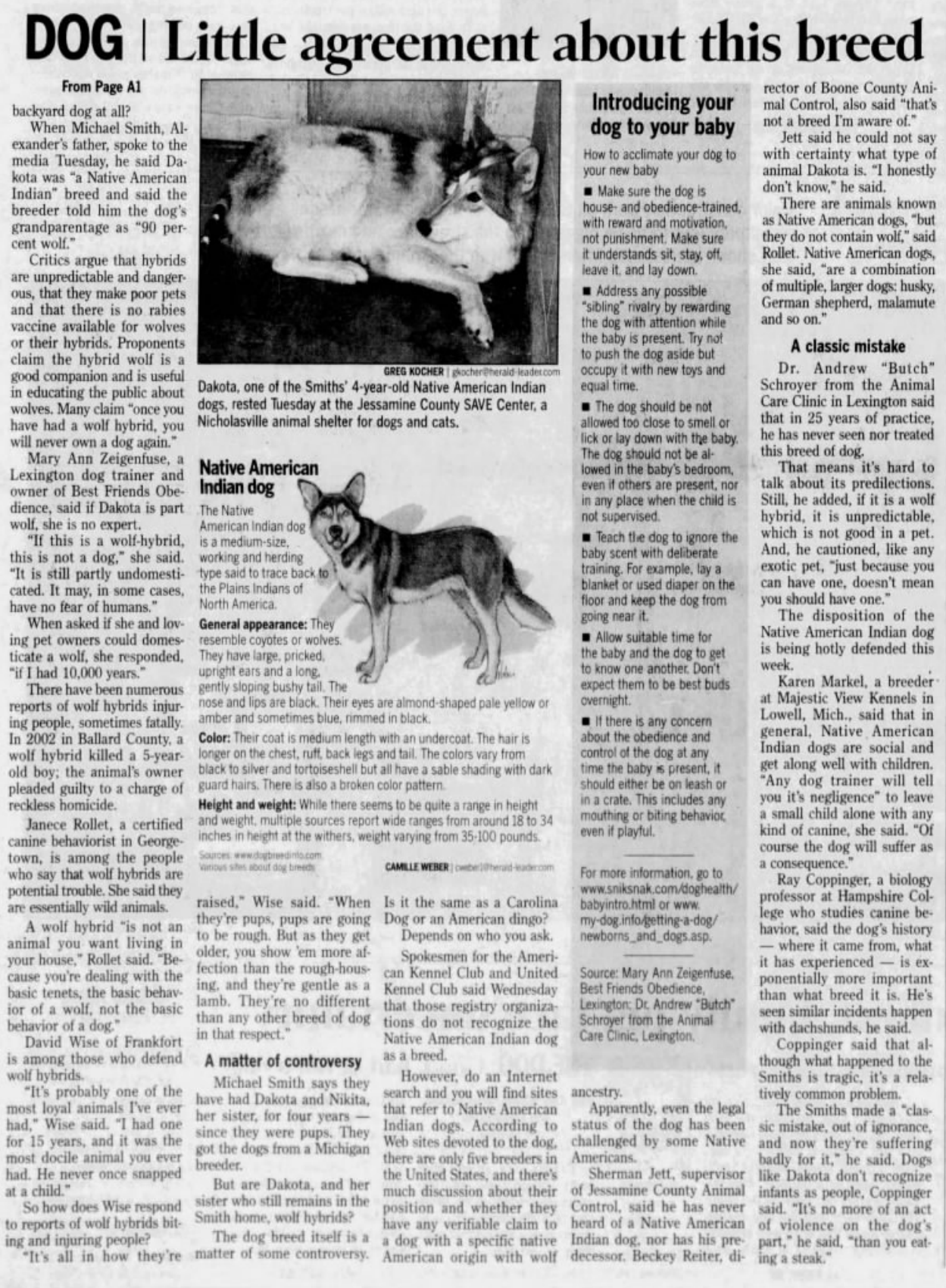
Little agreement about this breed
The report places disputed breed identity, an owner’s claimed wolf ancestry and contrasting views of temperament together. Markel is quoted defending NAIDs’ sociability and warning against leaving a small child alone with any dog.13
Wolf Dog Facts presents this account of the NAID name and Majestic View’s history.7
EXCERPT / THE AUTHOR’S ALLEGATIONS
Native American Indian Dog (also known as NAID) is a work-around term which wolfdog breeders use to sell their pups. The person who is supposedly responsible for the NAID is a lady by the name of Karen Markel from the state of Michigan who owns and operates a facility known as Majestic View Kennels. This facility was known for producing wolf hybrids or wolfdogs.
Prior to the year 2000, this facility was taking heat for breeding wolfdogs. There were many reports of how these dogs were vicious and aggressive. There were also many reports of attacks on animals and humans, to include young children. Many of these attacks were by dogs reported to be purchased from Majestic View Kennels in Michigan. With all of the negative reports about wolfdogs, Karen Markel stopped referring to her dogs as a wolfdog or wolf hybrid and started calling her dogs Native American Indian Dogs (NAIDs).
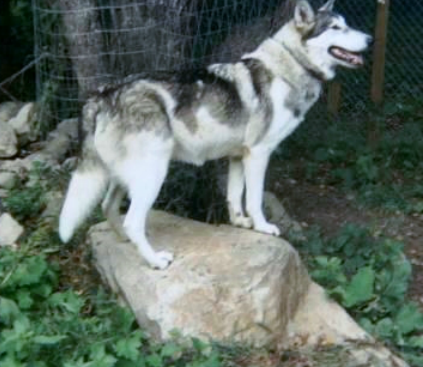
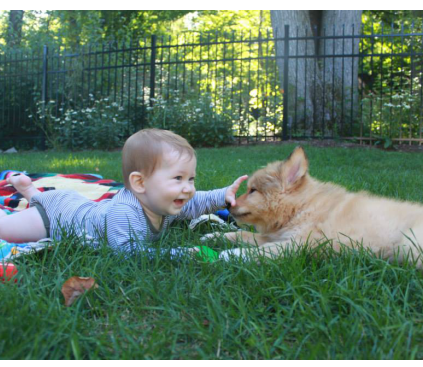
These companion images are not photographs of the newspaper incident, but are directly supplied by Majestic View's website.
Related 2009 reporting: different Native perspectives on the name
Karla Ward’s Herald-Leader report, republished by ICT on 7 August 2009, records Charles Huddleston’s objection to the name and Helen Danser’s different interpretation.14
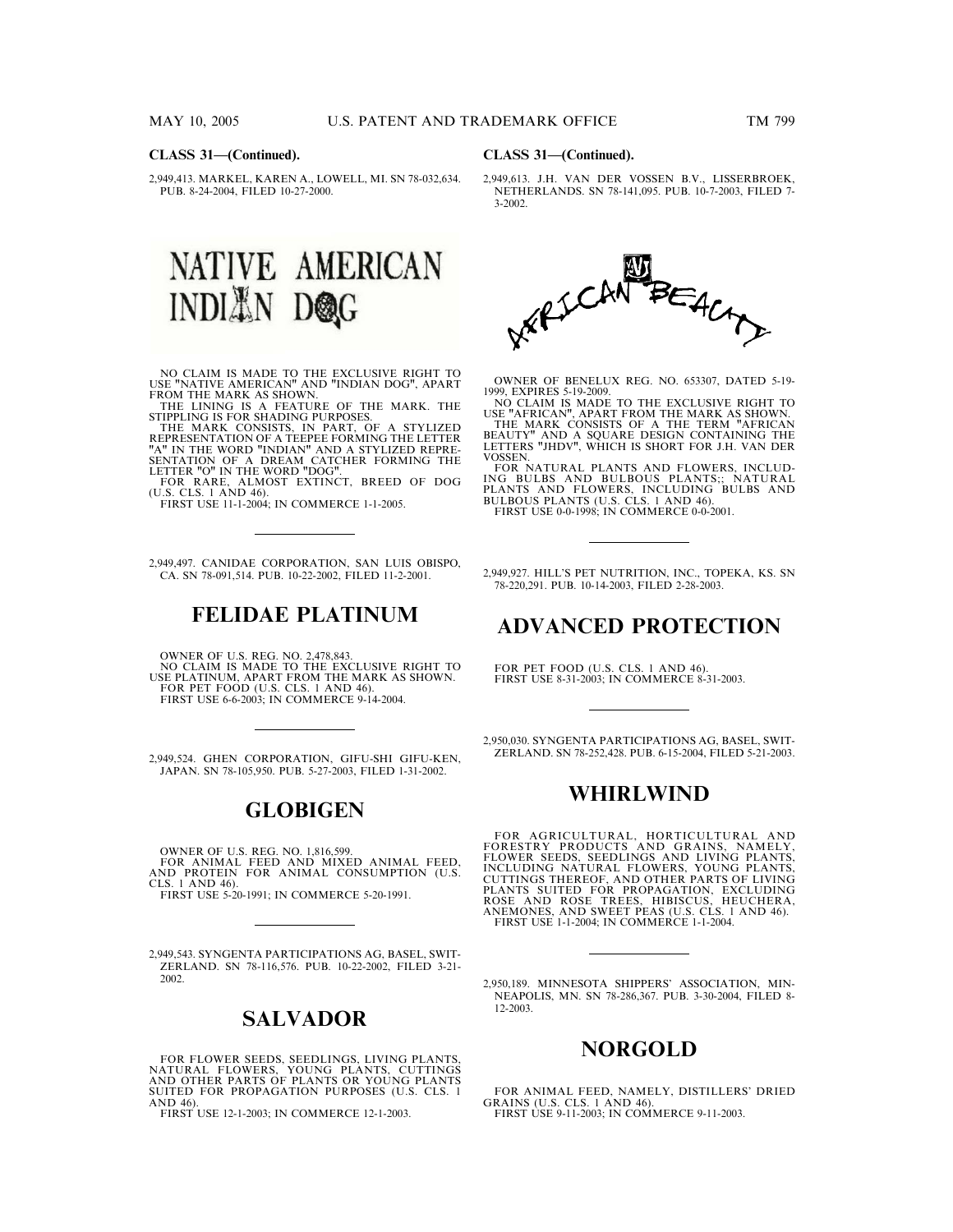
The USPTO’s 10 May 2005 gazette records Karen A. Markel’s composite Native American Indian Dog mark: registration 2,949,413, serial 78032634, filed 27 October 2000. The displayed design includes stylized lettering and imagery.1
“NO CLAIM IS MADE TO THE EXCLUSIVE RIGHT TO USE ‘NATIVE AMERICAN’ AND ‘INDIAN DOG’, APART FROM THE MARK AS SHOWN.”
This historical registration concerns the composite word-and-design mark as a whole, including its stylized lettering and imagery. It expressly disclaims exclusive rights to “Native American” and “Indian Dog” apart from that mark. That is different from owning a breed or controlling all breeding. The disclaimer alone does not settle every possible right in the full name, and protection is not necessarily limited to exact copies of the artwork. Present status and any other registrations remain unverified.2
USPTO · 10 May 2005 · TM 799 Open to inspect the full page.
THREE DIFFERENT MECHANISMS
The name, the permission, the contract.
The kennel’s history page connects its breeding program with Indigenous peoples’ historical relationships with dogs, including accounts of breeding and training. Its homepage presents a mission of restoring dogs described as lost or extinct. These are the kennel’s stated heritage claims.
“Maybe the U.S. Govt. Felt some remorse for treating indigenous people's so badly and decided to let the type of dog that was utilized for millennium be their own breed.”
AUTHORIZATION / AUGUST 8, 2026
“There is only 1 (one) Authorized breeder of the NAID(R) and the NAID designer dog mixes, besides myself the creator, founder and owner of the U.S. Trademark on the breed.”
A historical composite registration exists. Its present status and full scope need confirmation.
Approved breeders
The supplied August 8, 2026 post claims one authorized breeder besides the founder. A complete authorization policy or roster remains unverified. A private approval scheme does not itself establish universal legal control.
The sale agreement
The supplied terms impose consequences for unauthorized breeding, including an offspring claim or $5,000 per puppy and a further $35,000 amount described as a fine. How these combine and whether they are enforceable remain unresolved.
If preservation is presented as a responsibility to Indigenous peoples, who participates in deciding the terms—and what role do those communities actually hold?
Heritage rhetoric, trademark rights and contractual restrictions deserve separate evidence. Other sellers using the same breed label do not alone prove infringement, permission or biological equivalence.
THE RESTORATION CLAIM
Bringing back what was lost.
The kennel’s homepage explicitly describes a mission to restore dogs it says became extinct. That establishes its stated purpose; it does not demonstrate continuity with pre-colonial populations.4
THE KENNEL’S PUBLISHED CLAIMS
The supplied posts, dated to 2026 by the editor, show an August 8 claim of one authorized breeder besides the founder, an August 9 speculation about the U.S. government and heritage, and an August 9 trademark-certificate post. These document what the kennel published, not universal legal control over breeding.
Descriptions of a rare surviving population and a reconstruction of an extinct population are different propositions. Foundation pedigrees, acquisition records and specifically attributed community accounts are needed to assess which is being claimed.
CONTESTED ORIGINS
Read the competing stories.
COMMUNITY CRITICISM
naturepunk on Tumblr
The discussion combines reported rescue encounters, community accounts and criticism of the kennel’s origin narrative. Those contributions are identified separately on Testimonials.6
Corn Moon credits Karen Markel’s foundational role and explicitly lists low-content wolfdogs among early outcrosses. It describes modern NAIDs as domestic working companions. Its account offers another program’s perspective on the NAID’s development.8
The Coast Salish woolly-dog research combines genomics with Indigenous Knowledge and examines a particular relationship disrupted by colonialism. Ancient-American-dog research traces wider population changes. Neither supplies a pedigree for this kennel.12
Claims about dogs belonging to Indigenous peoples need specific voices, relationships and records. We should not substitute a breeder’s authority—or our own—for those communities.
FOLLOW THE EVIDENCE
Notes & sources
USPTO Official Gazette, 10 May 2005, TM 799. Registration 2,949,413; serial 78032634; Karen A. Markel. PDF downloaded, text checked and page visually inspected on 16 October 2026. This is a historical record, not current-status confirmation. Open official record at page 799 ↗↩
USPTO, trademark basics and disclaimer guidance. A disclaimer limits an assertion of exclusive rights to specified matter apart from the composite mark; it does not erase every possible right in the mark as a whole. Read disclaimer guidance ↗↩
Current agreement supplied directly by the breeder to the editor for 2026 onward. The unauthorized-breeding paragraph contains restrictions and penalties. Enforcement and permission practices have not been independently established. Read the supplied agreement ↗↩
Majestic View homepage, mission statement. The claim of restoring extinct dogs is attributable to the kennel; it is not independent genealogical evidence. Checked 16 October 2026. Read the mission statement ↗↩
Editor-supplied Facebook screenshots now document an August 8 authorized-breeder claim and two August 9 posts about heritage and trademark registration. The editor confirms the August posts are from 2026. The March 16, 2024 mission post remains a separate unresolved lead. Open the trademark post ↗↩↩
naturepunk, retrieved post 99428117710. Includes reported rescue encounters and broader community narratives. Post 126067114355 remains inaccessible. Read the retrieved Tumblr discussion ↗↩
Wolf Dog Facts, NAID VS. AID. Featured article excerpt supplied by the editor. It alleges wolfdog breeding, attacks and rebranding to evade restrictions; documentary evidence establishing these allegations has not been supplied here. The adjacent newspaper does not establish that Majestic View sold the dog in that incident. Read the essay ↗↩
Corn Moon Medicine Dogs, history page dated 16 April 2026. Breeder-authored claims, including early outcrosses and a preservation narrative, require their own records. No independent authentication of every historical statement was completed. Read Corn Moon’s account ↗↩
The editor identifies both companion photographs as originating from Majestic View’s website. They are separate from the newspaper incident. Appearance alone establishes neither ancestry nor temperament. Open supplied standing-dog image ↗↩
2023 Coast Salish woolly-dog study and 2018 ancient-American-dog genomics are independent historical sources. Neither establishes a pedigree for a modern commercial NAID program. Read the Coast Salish study ↗↩
Lexington Herald-Leader, 23 July 2009, page A2: DOG | Little agreement about this breed, continued from A1. Supplied PDF visually inspected. The continuation does not display a byline. The owner describes a Michigan breeder without naming one; Markel is quoted separately, so her comment does not establish that she sold this dog. Open the original newspaper page ↗↩
Karla Ward, The Lexington Herald-Leader / MCT, Some Native Americans offended by description of dog that attacked baby, republished by ICT with a 7 August 2009 publication date. The page also displays a 28 November 2025 update. This is a separately retrieved report, not a verified match to the supplied newspaper scan. Read the accessible 2009 report ↗↩